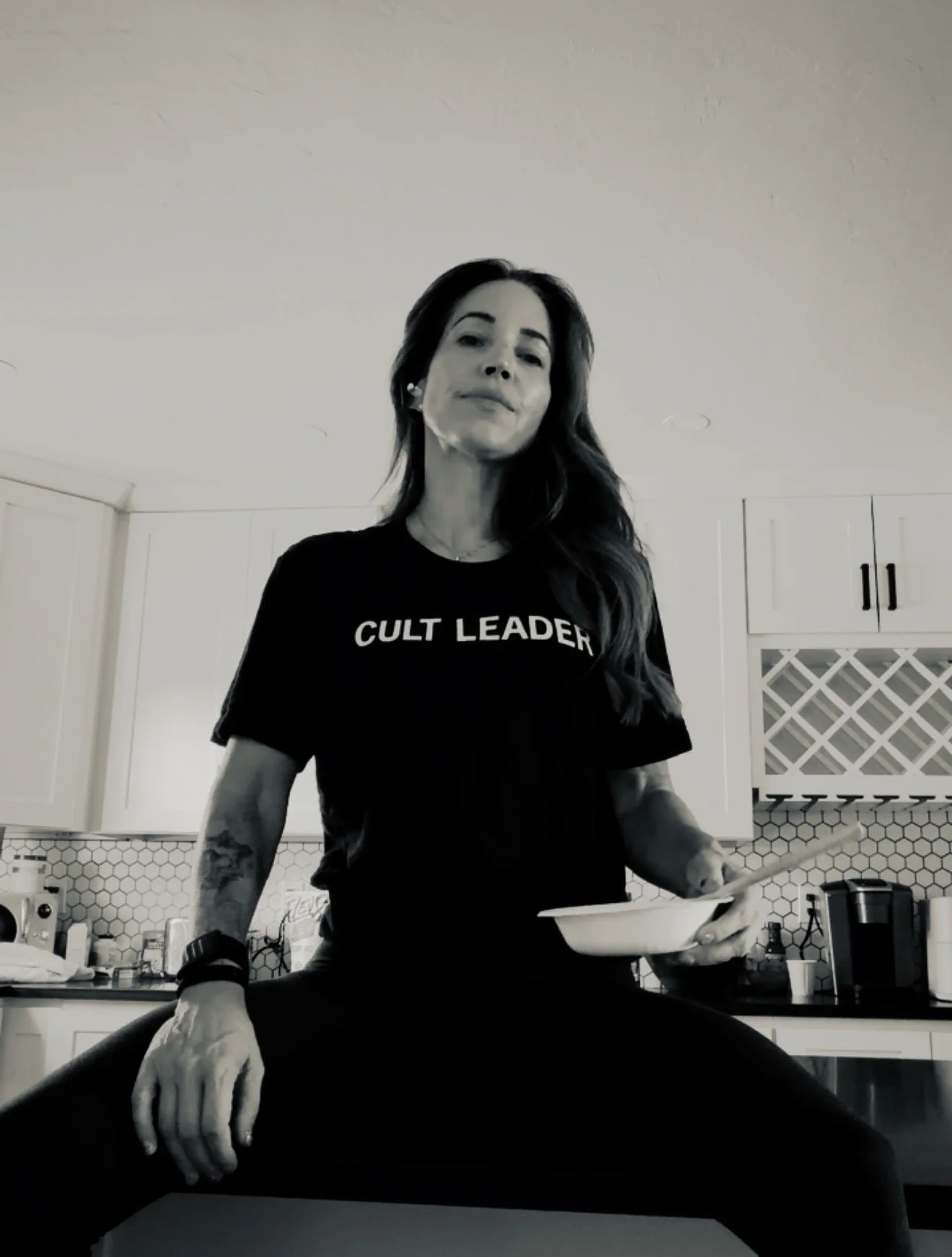
On Saturday night I climbed onto my kitchen island with a paper bowl full of cake batter and a spatula and ate dinner.
There was nothing especially dramatic about it. I was home alone, wearing a black T-shirt that said CULT LEADER, which made the photograph I took look considerably more confrontational than the evening actually felt. In reality, I was content. More than content, probably. There was a simple pleasure in realizing that no one was going to come through the door and ask what I was doing, what I had eaten, what the plan was, whether I intended to make something else, or whether this qualified as dinner. I was not misbehaving. There was nobody there whose definition of behaving mattered.
That distinction has become increasingly interesting to me.
Freedom is usually described in expensive language. It is the new apartment, the passport, the declaration, the reinvention. It shows up wearing a good coat and carrying luggage. We tend to recognize autonomy most easily when it photographs well. What interests me now are its less dignified forms, the small domestic permissions that barely register until you realize how long they were unavailable.
Eating cake batter out of a paper bowl is not an achievement. It will not appear on anyone’s list of markers for psychological growth. There is no research paper recommending it as an intervention, and no respectable therapist is likely to assign it as homework. That may be precisely why I loved it. It was useless. It solved nothing. It improved nothing. It did not advance the divorce, clarify my future, organize my finances, repair my nervous system, or make me a better person. It was simply what I wanted to do on a Saturday night, and therefore I did it.
There is luxury in that kind of uselessness after a life in which so much energy has been directed toward function.
Women become remarkably sophisticated systems of accommodation without necessarily realizing it. We learn the moods in the room, the preferences, the thresholds, the subjects that can be raised and the ones that cannot. We learn when to ask, when to wait, when to soften something, when to pursue it, when to stop pursuing it, and when to carry it ourselves because carrying it is easier than negotiating its existence. None of this has to announce itself as submission. Often it looks like competence.
Competence is dangerous that way. It can conceal how much of a person’s life has become administrative.
For years I was very good at managing things. I could anticipate difficulty, absorb conflict, solve problems, protect people, keep moving. I could become much louder when necessary, sharper when necessary, more forceful when necessary. I could occupy the unpleasant position in the room if it meant something got handled. There is a certain pride in being the person who can carry more than everybody else. There is also a point at which carrying becomes so habitual that nobody, including you, remembers to ask why it is yours.
Living alone has introduced me to the inverse of that arrangement. Not loneliness. Absence of assignment.
There are evenings now in which nobody needs anything from me. Nobody’s mood has jurisdiction over the room. No silence has to be deciphered. No withdrawal has to be compensated for. No unresolved problem is sitting invisibly at the table waiting for me to become sufficiently uncomfortable that I finally pick it up.
I am still getting used to how quiet that is.
Not quiet in the sentimental sense. I do not mean peace as a scented candle or a linen sofa. I mean the absence of occupation. There are forms of relationship that consume enormous psychological square footage without appearing particularly dramatic from the outside. A person does not have to shout to dominate an atmosphere. Silence can do it. Ambiguity can do it. Withholding can do it. The constant requirement to interpret another person can do it.
When that pressure disappears, the first sensation is not always transcendence. Sometimes it is bewilderment. You find yourself standing in your own kitchen with nowhere you are required to be psychologically, and for a moment you do not know what to do with the vacancy.
Apparently, I eat cake batter.
There was something almost indecently satisfying about sitting on the island rather than at the table, using a spatula rather than a spoon, and making no effort to turn any of it into an adult meal. It felt faintly feral, but not reckless. More like discovering that civilization had been optional in several places where I had assumed it was compulsory.
I have become suspicious of the language of recovery because it can turn freedom into another performance. Once a woman leaves something difficult, she is immediately handed a new set of obligations. She must heal correctly. She must learn the lesson. She must become stronger, wiser, calmer, more discerning. She must transform pain into wisdom with enough elegance that everyone feels reassured by the outcome.
Sometimes I do not want to transform anything.
Sometimes I would like to eat cake batter for dinner.
There is sovereignty in refusing to make every experience useful.
The older I get, the more I think autonomy is less about grand declarations than about recovering preference. Preference is primitive. It precedes argument. I like this. I do not like that. I want to stay. I want to leave. I want quiet. I want company. I want dinner. I want cake batter. These statements sound embarrassingly simple until you have spent enough time in circumstances where every preference acquired consequences, negotiations, explanations, or somebody else’s emotional weather.
Then simplicity begins to feel almost radical.
The photograph catches something I did not understand when I took it. I am sitting there in that rad shirt, looking vaguely pleased with myself, holding a paper bowl as though I have just completed some hostile acquisition. It is visually darker than the memory. That seems appropriate. Freedom does not erase what preceded it. The shadows remain in the photograph because they remain in the person. The difference is that they no longer dictate the evening.
I was happy that night.
Hours later, I remembered that it was my ex husband’s birthday.
The coincidence was so perfect that it would have been unbearably corny if I had planned it. I had not.
.