It was not because he had hit me or anything like that.
It was because I learned that my husband had done something to me in secret while I was passed out after a night of drinking and had then allowed me to live beside him for years without knowing. I am deliberately not describing the act itself because doing so would require me to disclose something intimate about my own body that I do not want to make public. I do not believe I should have to surrender more of my privacy in order to explain why losing it inside my marriage changed me. At first, I did not know why he had done it. I only knew that I had discovered something accidentally that made no sense inside the marriage I thought I was living in.
A boundary involving my privacy and bodily autonomy had been crossed while I was basically unconscious.
Whatever had happened had been concealed from me for years, during which time I had continued living with the person who had done it without possessing information that might have changed how safe I felt beside him.I kept asking why. I wanted to understand why someone would secretly do something to his wife while she was asleep, why he would keep it from her afterward, and how he could continue participating in an ordinary marriage while knowing that she did not understand something significant that had happened to her.
At the time, I was not trying to build an argument for leaving.
I was trying desperately to construct an explanation that would allow me to stay. We went to therapy, in part, because he repeatedly said he did not know why he had done it. I believed that if we could identify a reason, perhaps we could understand what had happened between us and determine whether it could be repaired. I was still approaching the problem as something a marriage might survive if two people were willing to examine it honestly enough.Then one day a year later, standing in the kitchen, he gave me an answer. He said it had been revenge. He said it matter-of-factly, and what frightened me was not only the word itself but everything the word required me to understand retrospectively.
There had been no grievance I remembered being invited to discuss. There had been no conflict presented to me in which I had been allowed to hear what he believed I had done, respond to it, apologize if necessary, disagree if necessary, or participate in repair. I was learning that something could happen entirely inside another person, become serious enough in his mind to justify retaliation, and still remain completely outside my awareness.I remember the physical sensation of hearing it. It felt as though the blood left my body before my mind had caught up with the sentence.
The person I had been married to for more than two decades was telling me that he had retaliated against me secretly.
He had not told me he was angry and then behaved badly in the heat of an argument. He had not demanded accountability or asked for space or tried, however clumsily, to resolve whatever he believed had happened between us. He had made a private determination, acted on it, concealed it, and continued living beside me while I remained unaware. I did not perceive remorse in that moment. I perceived a statement of fact, and something in my understanding of the marriage shifted.What happened next is important because learning this did not end my marriage. I stayed for another four years or so. I stayed because I was still trying to make the marriage safe again. I brought what had happened into therapy. I talked about it with doctors and therapists years before I was considering divorce, because I was trying to understand what was happening to me psychologically and physically inside a marriage I still intended to preserve.
I documented what I was experiencing because I was frightened and disoriented.
The record of my fear began long before the end of the marriage was something I believed I was moving toward. For those years, I kept waiting for something that would restore what had been damaged. I thought perhaps enough therapy would produce an explanation that made sense. I thought accountability might eventually arrive. I thought he might understand why learning that something had been done secretly while I was asleep had altered my ability to feel safe around him. I thought repair might involve him becoming actively concerned with whether I felt safe, rather than treating safety as a problem I was responsible for solving internally. I was not asking to forget what had happened. I was asking for enough honesty, accountability, protection, and relational repair that I could integrate it into the history of the marriage without remaining afraid of the person I was still living with.That never happened.
This is the part of staying that I think people often misunderstand.
Remaining in a marriage after something frightening does not necessarily mean the frightening thing stopped mattering. Sometimes it means the person who was hurt is working extraordinarily hard to make sense of it because leaving an entire adult life is not an instantaneous psychological act. I had a home, a family, financial dependence I did not fully understand how to unwind, and more than two decades of attachment to the person in the next room. I did not control the finances. I did not know where I would go. I did not know how I would support myself. I did not yet understand what options I had. More importantly, I still believed the relationship might be repairable.
The situation eventually warranted my insistence on separate bedrooms.
Before I had a lock installed, I began putting things in front of my bedroom door at night. I knew there was something profoundly wrong about arranging objects against a door inside my own home because I was frightened of the person sleeping elsewhere in it, but knowing that did not make the fear disappear. I was afraid because the discovery had changed the range of behavior I believed was possible. Until then, even when my husband was withdrawn, avoidant, angry, difficult, or overwhelmed, I thought I understood the perimeter. I believed that if he had a serious grievance with me, eventually I would know about it. I believed there would be some observable sequence between anger and action. I believed that whatever problems existed between us were occurring inside a shared reality, even if we understood that reality differently.The discovery destroyed that assumption.I had learned that he could be angry without telling me. I had learned that he could experience a grievance without bringing it into the relationship.
I had learned that he could decide privately that I deserved retaliation and act without allowing me to know what I had supposedly done.
Most frighteningly, I had learned that something significant could happen in secret and remain secret for years while ordinary married life continued around it. After that, sleep changed. Privacy changed. The house changed. I began asking questions I had never needed to ask before. If I had discovered this only by accident, what else did I not know? If I had misunderstood the range of behavior available to the person beside me, what exactly was that range? I was not suddenly claiming that every terrible possibility I could imagine had happened. The fear came from realizing that my previous confidence about what could not happen was no longer reliable.
That uncertainty produced a kind of hypervigilance I had never experienced inside my marriage before.
I began paying attention differently. I documented things. I told professionals what I was experiencing. I had night terrors and needed help sleeping. For roughly two and a half to three years, the bedroom door became part of the emotional geography of my marriage. At night, I could be frightened enough to barricade myself inside a room. In the morning, I still had to walk into the kitchen.That was perhaps the most surreal part of those years. Morning does not care what happened the night before. Dogs still need to be fed. Coffee still gets made. There are errands and appointments and ordinary questions about ordinary things. I would leave the room in which I had been trying to make myself feel physically secure and enter the shared spaces of a home where I was still expected to function normally beside the person whose behavior had made the lock feel necessary.
I stayed inside that contradiction for years.
I kept trying to explain what I needed from him in order to feel safe again. I kept believing there was some combination of therapy, understanding, accountability, remorse, and repair that would return me to the marriage I thought I had occupied before I learned what I learned. There is something devastating about realizing that safety cannot be restored through the effort of the frightened person alone. I could explain the injury perfectly and still could not perform his half of the repair. Eventually, that became information too. For a long time I felt shame about not having understood sooner. I wondered how I could have lived beside someone for so many years without recognizing that he was capable of holding a grievance privately, retaliating in secret, and then allowing me to continue living inside a reality from which important information had been removed.
I treated my own trust almost as evidence of stupidity.
I do not anymore.Trusting the person you married to tell you when he is angry is not a character defect. Assuming that grievances will be communicated rather than converted into secret punishment is not naïveté so extreme that it deserves shame. I could only make decisions inside the reality available to me. I could not incorporate information I did not possess.That eventually became one of the largest questions of my marriage, far beyond the bedroom itself. What does consent to a shared life mean when one person possesses material information about that life and the other does not?
How many decisions do we make about whether to stay, trust, forgive, build, invest, or continue based on what we believe the reality of the relationship to be? I lived for years beside someone while not knowing something about my own experience that he knew. When I finally did know, I did not leave immediately. I stayed for four more years trying to restore safety. I went to therapy. I talked to doctors. I tried to understand. I tried to repair. I continued living inside the marriage because I wanted the answer to be that something terrible could happen and still be repaired if both people were willing to confront it honestly. What I eventually learned was more painful than the hope I started with.
A relationship cannot become safe again because one person desperately wants it to. Repair is not the same thing as endurance, and staying is not proof that repair occurred. For years, I stayed. For years, I tried. And for years, before I closed my eyes at night, I locked the bedroom door.
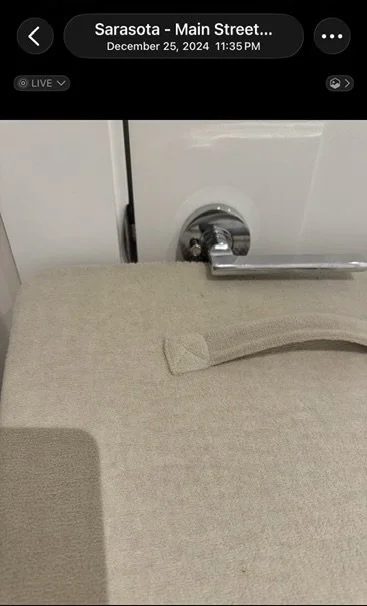
before the lock was upgraded, I’d use the dog steps to wedge under the door handle. December 2024.