My ex-husband’s work in the disability community has a positive impact on the lives of others.
There were young adults working in the café, families who believed in what it represented, donors who wanted to help, and a Sarasota community that responded enthusiastically to the mission. I believe in the value of his work, and I genuinely want it to succeed. Over time, however, my investment in its success became increasingly entangled with a personal sense of responsibility for protecting his reputation and preserving his dignity. It would take me years to understand how much of my own life I had devoted to that responsibility.
BY THE FALL OF 2023, I HAD BEGUN TO UNDERSTAND THAT I WAS STANDING MUCH CLOSER TO THE MACHINERY THAN I HAD EVER INTENDED TO BE.
My husband’s work in the disability community had always been presented, publicly and privately, as mission-driven. There were young adults working in the café, families who believed in what it represented, donors who wanted to help, and a Sarasota community that responded enthusiastically to the story. I believed in the mission too, and I wanted the work to succeed. For a long time, that belief made it surprisingly easy to overlook the difference between supporting a mission and understanding how the organization carrying it out was actually being run.
By the fall of 2023, however, I had begun noticing things that made me uncomfortable. Money was tight, and decisions involving significant amounts of it seemed to happen unilaterally, with explanations sometimes arriving only after the fact. I learned about certain things accidentally; others emerged because I asked a question and discovered that the answer raised several more.
ONE OF THOSE QUESTIONS INVOLVED A DONATION MADE BY A MAN NAMED JIM.
Jim had contributed money for a food truck, a project that ultimately never happened. When he later asked what had become of the money, I asked my husband and was told that the funds had instead been used for general operations because there was not enough money to keep the café open. What disturbed me was not simply that the intended use had changed. As I understood the situation, nobody had first gone back to Jim and explained that the project he had funded was no longer moving forward, that the money was needed elsewhere, and asked whether he was comfortable with that.
On November 15, 2023, I texted Jim myself. I told him that I had not neglected to address the donation he had made for the food truck and that my husband planned to speak with him about it. Then, despite having neither solicited the donation nor redirected the money, I apologized to Jim for what had happened.
That apology is the part that interests me now. I had not made the decision, yet I had somehow found myself standing between the person who had made it and the person affected by it, trying to repair the situation. At the time, I experienced that as responsibility. Looking back, I recognize it as something much more familiar.
MUCH OF MY MARRIAGE OPERATED THIS WAY.
Something would happen and I would discover it. I would become alarmed, angry, embarrassed or frightened, but somewhere between the discovery and the consequence, the problem would migrate across the room and become mine to manage. I would make the call, explain the situation, smooth over the discomfort, apologize or attempt to prevent whatever consequence appeared to be approaching. The work was largely invisible because invisibility was its purpose. If I did it well enough, no one outside the situation had to see how much was wrong inside it.
A month after my exchange with Jim, I was privately documenting broader financial concerns to someone in the Sarasota community. By then, I had learned enough to be skepticall by how the café and nonprofit appeared to be financially intertwined and by the amount of personal money that had been committed to keeping everything alive. I wrote about our line of credit, the donation intended for the food truck, and my concern that the business had repeatedly raised less money than it needed to operate.
What strikes me now is that, even in the middle of that alarm, my instinct was still to solve the problem rather than expose it. I suggested approaching The Haven about taking over the café. I believed The Haven had resources, infrastructure and a longstanding mission serving people with intellectual and developmental disabilities. I thought perhaps the café could survive inside an organization better equipped to sustain it and that the people working there could keep their jobs. I figured it was worth asking.
I also wrote that such an arrangement would allow my husband’s dignity to remain intact.
HIS DIGNITY.
I have gone back to that sentence several times because it captures something about me that I did not fully understand at the time. Even while I was frightened by what I was learning, I was still thinking about how to preserve him. I was thinking about his work, his standing in the community, his reputation and the version of himself other people knew. I was trying to protect the mission, but I was also trying to protect the story surrounding the person at the center of it.
By 2025, that had become increasingly difficult. My concerns had shifted somewhat from the financial survival of a café to the governance of the nonprofit itself, and I had become uncomfortable with what I understood to be unilateral financial decisions occurring without meaningful board process. I began documenting those concerns in writing because I no longer wanted my proximity to the organization to be mistaken for approval of decisions I had neither made nor fully understood.
That distinction became especially important when nonprofit money was spent in ways that benefited my own art studio.
THE FACT THAT I BENEFITED DID NOT MAKE ME LESS CONCERNED. IT MADE ME MORE CONCERNED.
I did not want to discover years later that expenditures connected to me were being justified by approvals I had never seen or decisions in which I had never meaningfully participated. I raised the issue directly and asked about board approval. I was told that approval had been obtained, but by then I wanted more than verbal reassurance.
Eventually I put distance in writing. I said that I would no longer participate in nonprofit work, asked for my name to be removed from anything associated with the organization, and told my husband to remove nonprofit-related materials from my studio. I wanted nothing around me that could later create the impression that I had knowingly participated in decisions that I did not understand and had not made. I wanted to ensure the board was above board and I had no direct access to find out.
THERE IS A STRANGE BANALITY TO LIVING BESIDE SOMETHING THAT TROUBLES YOU ETHICALLY.
Very little announces itself as a crisis while it is happening. More often, concern enters through ordinary life: a text message read while standing in the kitchen, a bank transaction, a conversation replayed in the shower, an answer that does not quite answer the question, a claim that something received approval, or repeated references to a board whose actual governing role you do not fully understand.
Then the dog needs to go out. There are groceries to buy. Someone calls. Dinner has to be made. You try to work. You sleep badly. Morning comes, ordinary life resumes, and whatever is troubling you remains embedded inside it.
For years, I confused vigilance with responsibility. I believed that if I noticed enough, asked enough questions, documented enough and intervened quickly enough, I could keep something truly terrible from happening. It is an exhausting way to live because there is no finish line. Every problem successfully managed becomes evidence that you should remain on duty for the next one.
Eventually I began to understand that the vigilance itself was changing the shape of my life. I was not simply noticing information. I was managing its movement. I was thinking ahead to conversations that had not happened yet, deciding what could be said and to whom, wondering what other people knew, what they had been told, and how much responsibility I carried for what might happen if different versions of the same story ever reached the same room.
That pattern eventually cost me something concrete.
I was offered an opportunity to work at a local organization to create a fine arts program for artists with intellectual and developmental disabilities. Under different circumstances, I would have accepted eagerly. I care deeply about that population, and I had already begun imagining the work, the artists and the possibilities.
I declined because I could not reconcile working inside an organization institutionally connected to my husband while carrying unresolved concerns about his nonprofit. I did not know how to enter that environment and behave as though one part of my life had nothing to do with the other. The professional opportunity and the personal reality had become too entangled for me to separate them cleanly.
That decision hurt, and it still does.
There is a point at which managing difficult information begins to occupy more territory than the information itself. You start avoiding situations because you do not want to explain yourself. You become careful around people you once spoke to casually. You decline opportunities because accepting them would create relationships you are not prepared to navigate. Eventually you realize that you are spending an extraordinary amount of energy managing the consequences of decisions you did not make.
That realization was one of the reasons I finally stepped away.
I do not want to monitor anyone else’s nonprofit. I do not want to spend the next chapter of my life acting as an amateur regulator, forensic accountant, prosecutor or investigator. I have no interest in making the previous chapter of my life into my permanent occupation.
WHAT I DO HAVE IS A RECORD.
The record matters to me because it allows me to see who I was while all of this was happening.
I can look at messages from 2023 and see what concerned me then, rather than relying on what I remember being frightened by now. I can see myself raising concerns privately, long before my marriage ended. I can see how consistently my first instinct was to solve problems quietly rather than expose them publicly. I can see myself trying to protect the mission, the people working inside it and, for longer than I understood at the time, my husband.
I can also see the point at which I tried to stop.
That is the part of the record I am most interested in now. It shows me how long I confused preservation with loyalty and how easily I mistook silence for restraint. I believed that keeping enough plates spinning was evidence that I was responsible, when in practice it often meant that nobody else had to see how precariously the plates had been stacked.
The hardest part has been recognizing that my impulse to protect people from consequences was not always generosity. Sometimes it was my own intolerance for watching the consequence arrive. If I could explain something, repair it, soften it or intervene quickly enough, I did not have to stand there and watch another adult encounter the result of his own decisions.
That is a much less flattering explanation than the one I used to give myself, but it is more useful.
I spent years believing that protecting other people from uncomfortable information was evidence of character. I thought loyalty meant absorbing the discomfort myself and responsibility meant stepping in before anything broke badly enough for other people to notice.
I understand responsibility differently now.
Sometimes it means acting. Sometimes it means documenting. Sometimes it means asking the uncomfortable question while there is still time for the answer to matter.
And sometimes it means recognizing that the problem belongs to someone else and leaving it there.
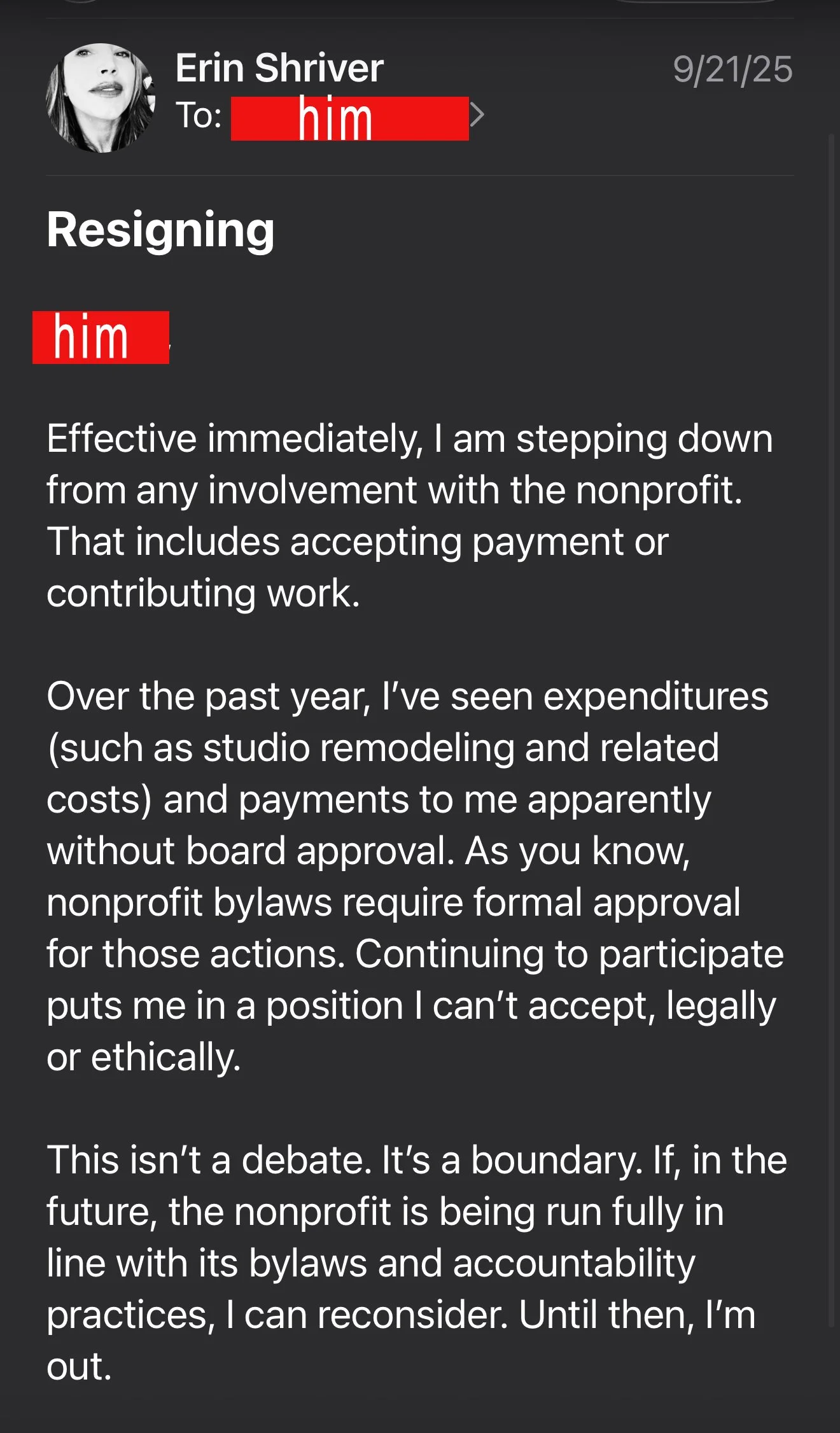
September 2025
Correspondence of my governance concerns in 2025
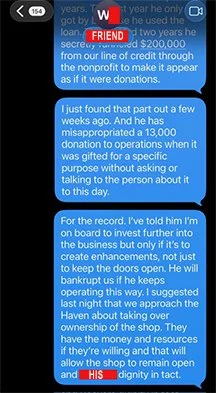
My attempt to get outside help and solve the business concerns for the issues I was discovering while also trying to keep his dignity in tact. This man didn’t reply to my attempt.
December 2023
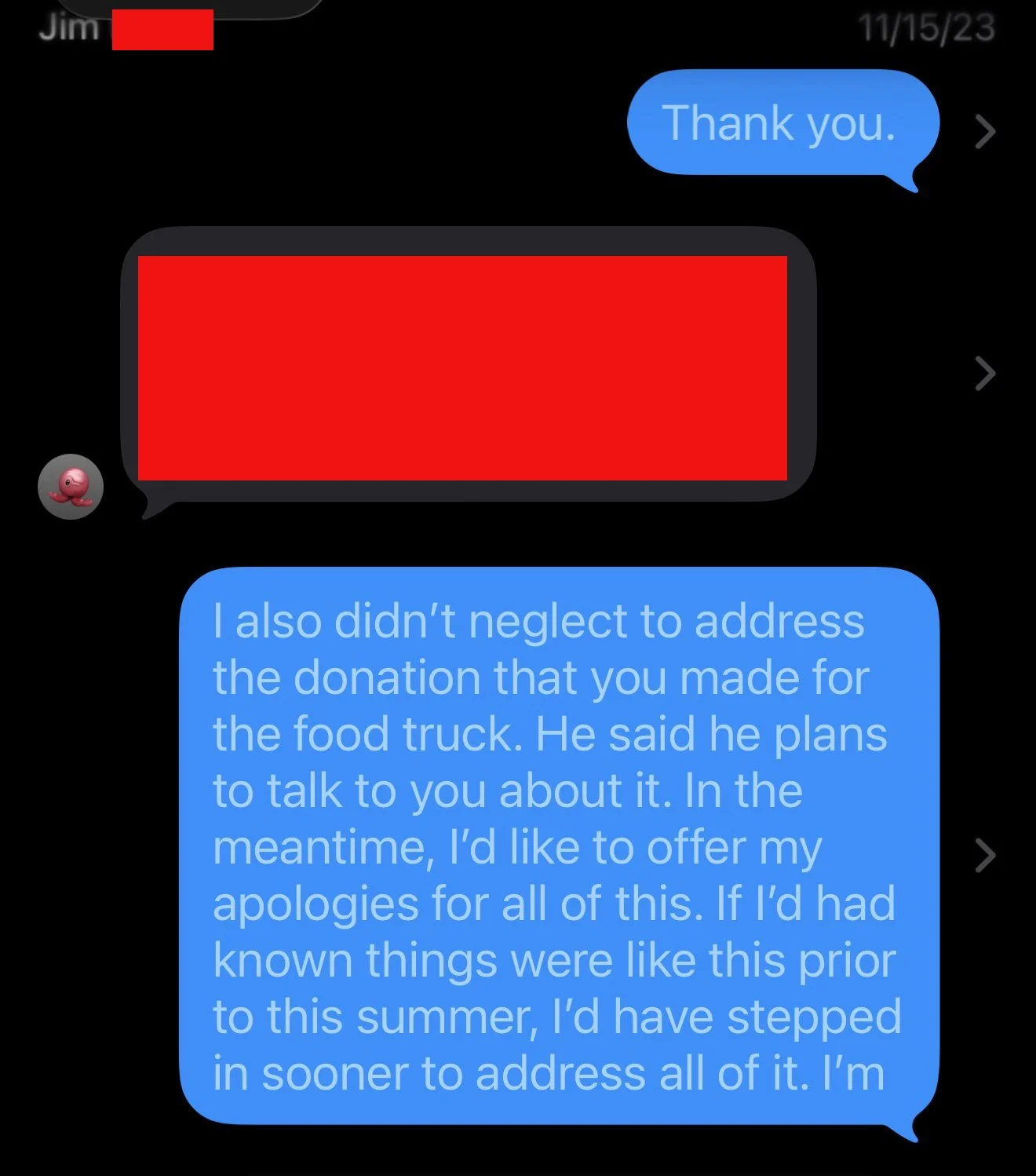
November 15, 2023
My apologies for something that I didn’t do.